🏛️ Chapter 3: Canada's History
3.2.4 The Beginnings of Democracy
2 paragraphs · 5 questions
Democratic institutions here grew slowly and without violence. The first elected representative assembly met in Halifax, Nova Scotia, in 1758. Prince Edward Island elected one in 1773 and New Brunswick in 1785. Then the Constitutional Act of 1791 split the Province of Quebec in two. Upper Canada, later called Ontario, was mainly Loyalist, Protestant and English-speaking. Lower Canada, later called Quebec, was heavily Catholic and French-speaking.
Key Facts
- First representative assembly elected in Halifax, Nova Scotia, in 1758
- P.E.I. followed in 1773, New Brunswick in 1785
- Constitutional Act of 1791 split Quebec into Upper and Lower Canada
- Upper Canada became Ontario; Lower Canada became Quebec
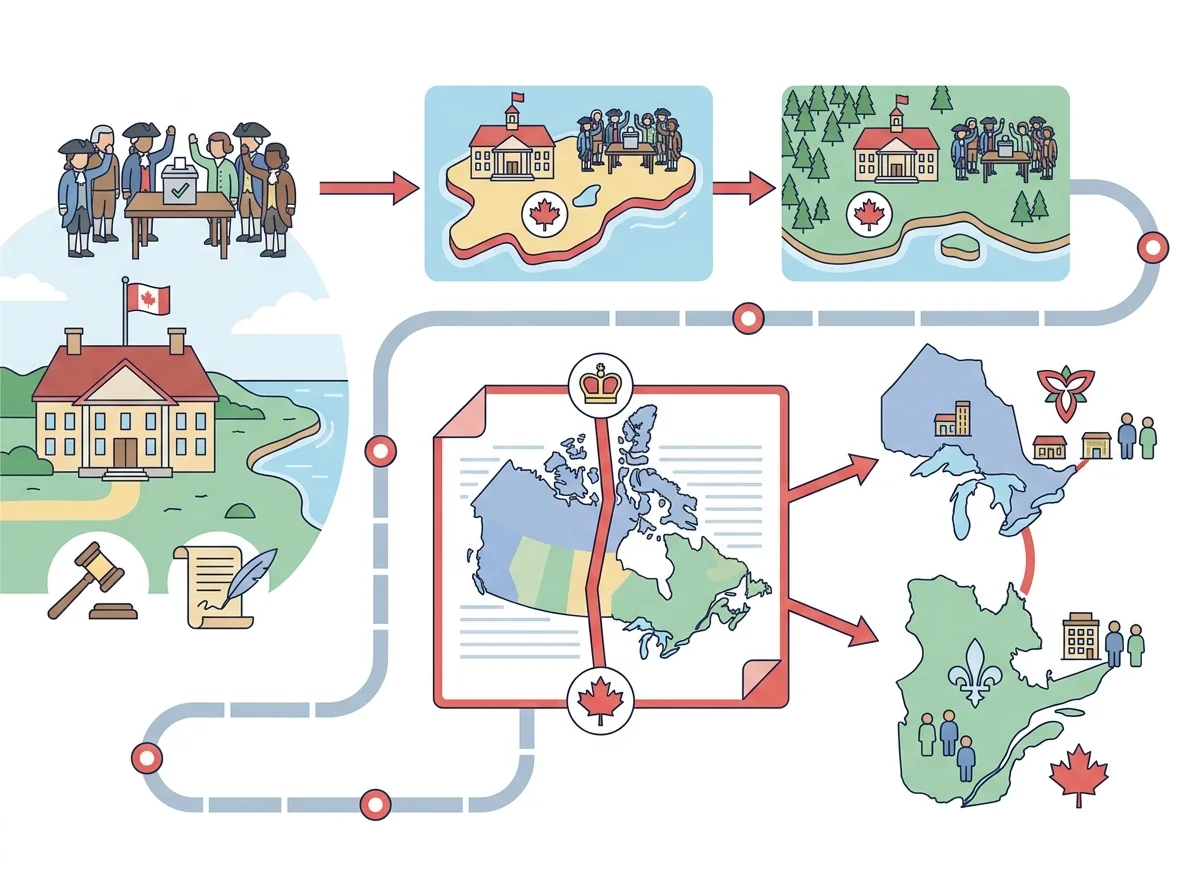
The same Act of 1791 gave the Canadas legislative assemblies elected by the people, for the first time. The name Canada also became official at that moment, and it has been used ever since. The Atlantic colonies together with the two Canadas were known as British North America. On January 21, 1793, the first elected Assembly of Lower Canada met in Québec City and debated whether to use both French and English.
Key Facts
- 1791 Act gave the Canadas their first elected legislative assemblies
- The name Canada became official in 1791
- Atlantic colonies plus the two Canadas = British North America
- 21 January 1793: Lower Canada's Assembly debates using French and English
Test yourself on this topic
5 practice questions from “The Beginnings of Democracy”, each with the answer explained.
- Where and when was the first representative assembly in Canada elected?
- What did the Constitutional Act of 1791 do?
- Upper Canada, created in 1791, later became which province?
- What were the Atlantic colonies and the two Canadas called collectively?
- What did the first elected Assembly of Lower Canada debate in January 1793?
Advertisement