
🏛️ Chapter 3: Canada's History
3.4.6 A Railway from Sea to Sea
2 paragraphs · 4 questions
Ottawa promised a railway that would reach the West Coast, and on that promise British Columbia agreed to join Canada in 1871. The last spike went in on November 7, 1885. Donald Smith, later Lord Strathcona, drove it. He was born in Scotland and directed the Canadian Pacific Railway (CPR). Finishing the line gave the young country a powerful symbol of unity. Years of heroic work lay behind it, and the CPR's "ribbons of steel" turned a national dream into reality.
Key Facts
- B.C. joined in 1871 on the promise of a railway to the coast
- Last spike driven on 7 November 1885
- Donald Smith (Lord Strathcona) was a CPR director, born in Scotland
- The CPR's "ribbons of steel" made a national dream real
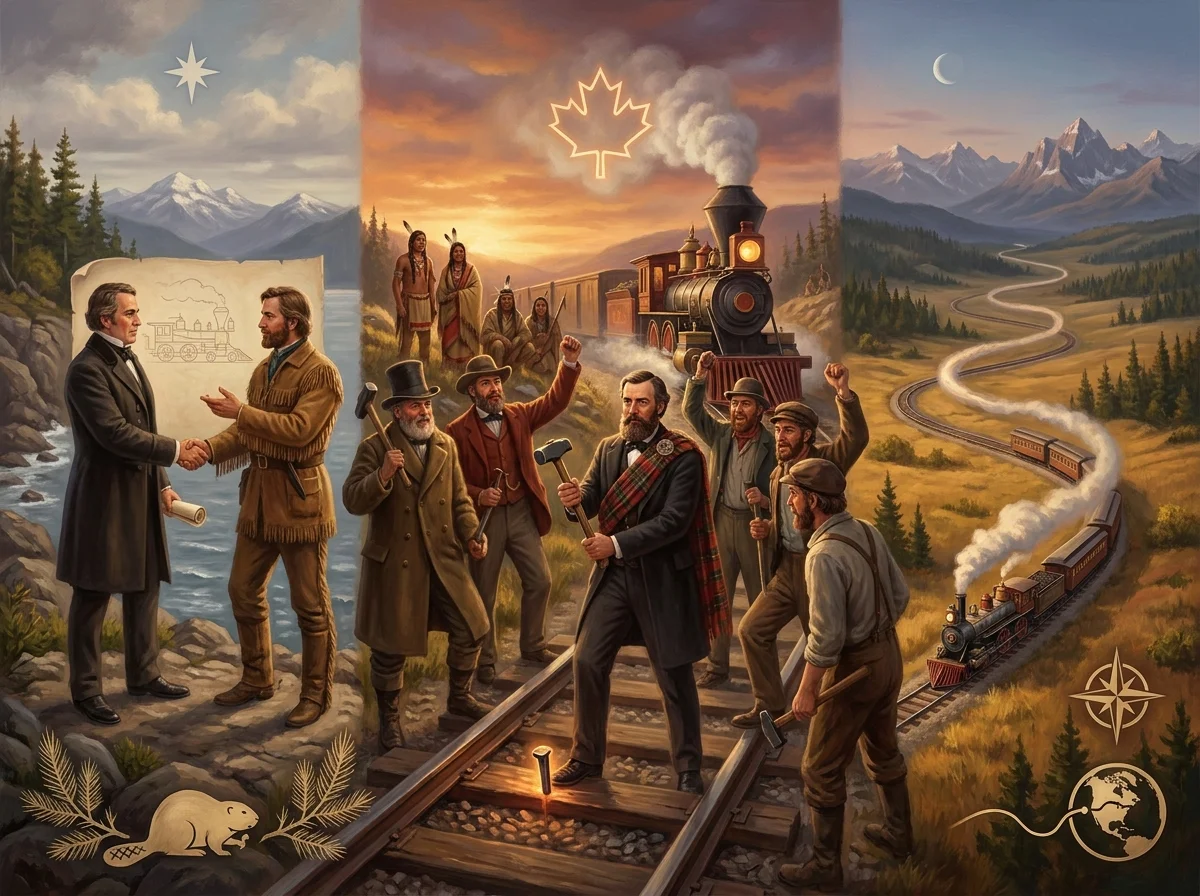
British and American investors financed the railway. It was built by both European and Chinese labour. After the work was finished, Chinese workers faced discrimination. One example was the Head Tax, an entry fee charged to people because of their race. The Government of Canada apologized for that discriminatory policy in 2006. Once complete, the line carried settlers and goods into the West and tied the country together.
Key Facts
- Financed by British and American investors
- Built by European and Chinese labour
- Chinese people later faced the Head Tax, a race-based entry fee
- Canada apologized for the Head Tax policy in 2006
Test yourself on this topic
4 practice questions from “A Railway from Sea to Sea”, each with the answer explained.
- What did Ottawa promise to bring British Columbia into Canada in 1871?
- Who drove the last spike of the Canadian Pacific Railway, and when?
- Who paid for the Canadian Pacific Railway, and who built it?
- What was the Head Tax, for which Canada apologized in 2006?
Advertisement