
🌆 Chapter 4: Modern Canada
4.4.2 Visual Arts
2 paragraphs · 6 questions
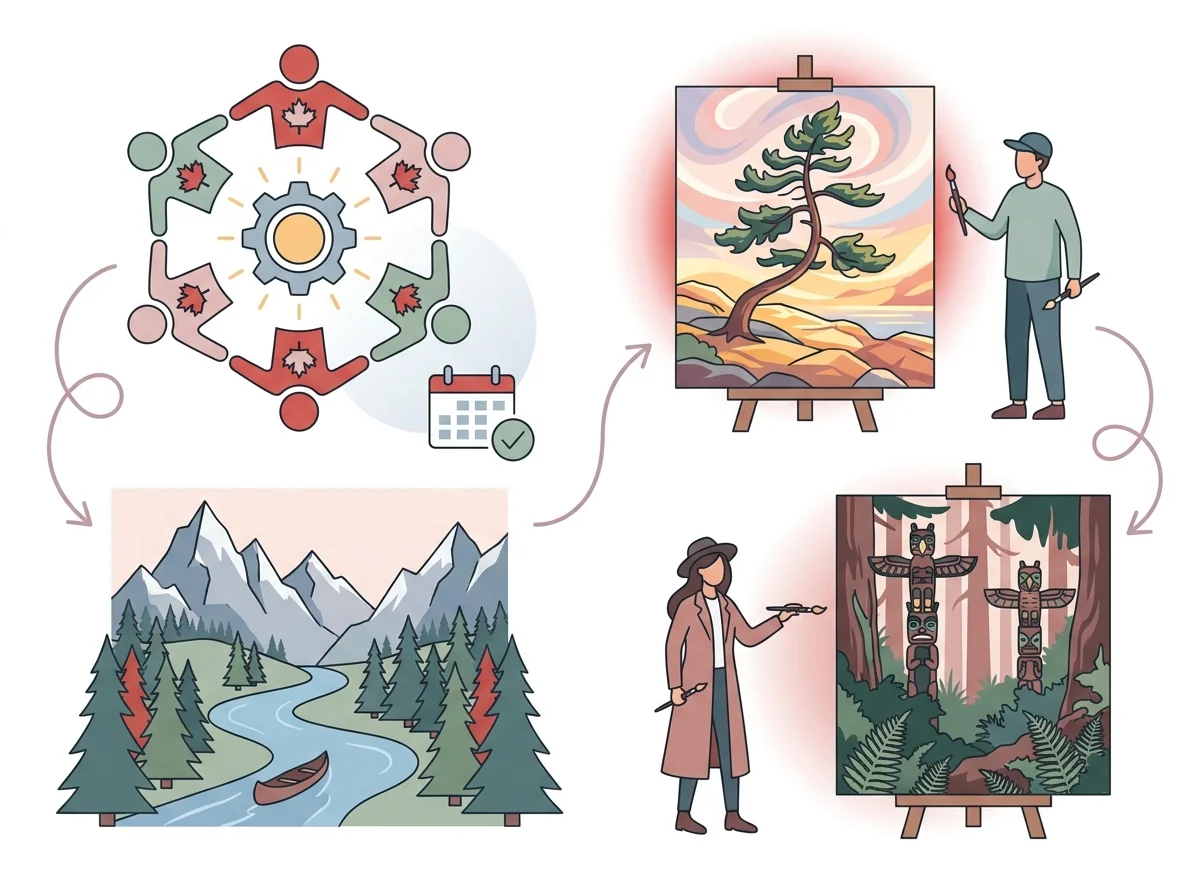
In painting, Canada is probably best known for the Group of Seven. The group was founded in 1920. Its members created a style meant to capture the country's rough, wild landscapes. Tom Thomson painted The Jack Pine, one of the best-known Canadian images. On the West Coast, Emily Carr painted the forests and the Aboriginal artifacts she found there. Pictures like these still shape how people imagine Canada.
Key Facts
- The Group of Seven was founded in 1920
- They painted rugged wilderness landscapes
- Tom Thomson painted The Jack Pine
- Emily Carr painted West Coast forests and Aboriginal artifacts
Quebec produced pioneers of modern art. Les Automatistes led the way into abstract painting during the 1950s. Jean-Paul Riopelle is the most famous of that circle. Earlier, Quebec's Louis-Philippe Hebert made his name carving figures from history. In the North, Kenojuak Ashevak opened the path for modern Inuit art. She worked in etchings, prints and soapstone sculpture. Taken together, these artists show how broad Canadian art has become.
Key Facts
- Les Automatistes pioneered abstract art in Quebec in the 1950s
- Jean-Paul Riopelle was the most notable of them
- Louis-Philippe Hebert was a celebrated sculptor of historical figures
- Kenojuak Ashevak pioneered modern Inuit art
Test yourself on this topic
6 practice questions from “Visual Arts”, each with the answer explained.
- Which group of painters is best known for its style of depicting Canada's wild, untamed scenery?
- In what year was the Group of Seven founded?
- Which painter is famous for West Coast forests and Aboriginal artifacts?
- Which Quebec group pioneered modern abstract art in the 1950s?
- Who was the most notable member of Les Automatistes?
- Which artist is credited with founding modern Inuit art through printmaking and carving in stone?
Advertisement