⚖️ Chapter 5: How Canadians Govern Themselves
5.1.2 Federal State
3 paragraphs · 14 questions
Canadians are governed at four levels: federal, provincial, territorial and municipal. Each level has its own work to do. The split of duties between Ottawa and the provinces was written down in 1867, in a law then called the British North America Act. That same law is known today as the Constitution Act, 1867. Under it, the national government deals with questions that affect the whole country or Canada's relations abroad. The provinces deal with matters closer to everyday life at home.
Key Facts
- Four levels: federal, provincial, territorial, municipal
- Powers were divided in 1867 by the British North America Act
- That law is now called the Constitution Act, 1867
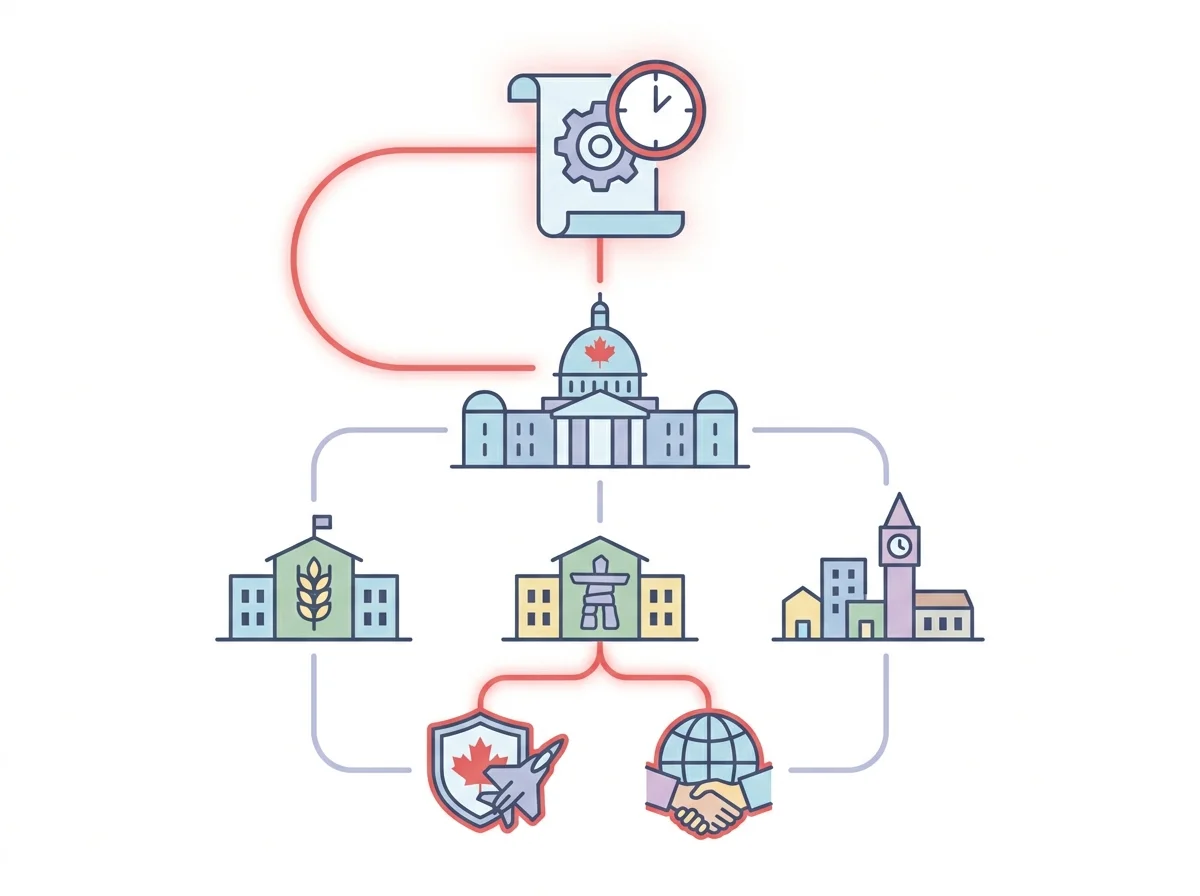
The federal government in Ottawa takes charge of subjects that are national or international in scope. Defence and foreign policy sit here. So do citizenship, criminal law and the currency. Trade and communications that cross provincial borders are federal, and so is navigation. These subjects touch every part of the country, so one government handles them for everyone. That keeps the rules the same from one coast to the other, no matter which province a person lives in.
Key Facts
- Ottawa handles defence and foreign policy
- Citizenship, criminal law and currency are federal
- Interprovincial trade, communications and navigation are federal
The provinces look after services people use close to home. Education, health and highways are provincial. So are natural resources, and property and civil rights. Municipal government is set up by the provinces as well. Two subjects are not owned by one level alone: agriculture and immigration are shared, which means the federal government and the provinces both have responsibility for them. Learning which level handles which subject is one of the most useful things to know about Canadian government.
Key Facts
- Provinces run education, health and highways
- Provinces handle natural resources and property and civil rights
- Provinces set up municipal government
- Agriculture and immigration are shared with Ottawa
Test yourself on this topic
14 practice questions from “Federal State”, each with the answer explained.
- Which four kinds of government operate in Canada?
- Which of these is a responsibility of the federal government?
- Which pair of subjects is handled by the federal government?
- Which of these national matters does the federal government look after?
- Which level of government deals with citizenship?
- Foreign policy and trade between provinces are the responsibility of whom?
- Which level of government is responsible for health?
- Who is responsible for natural resources?
- Highways are the responsibility of which level of government?
- Which level of government is responsible for municipal government itself?
- Property and civil rights fall under whose responsibility?
- Which TWO areas do the federal government and the provinces share?
- Which 1867 act defined the responsibilities of the federal and provincial governments?
- Which level of government is responsible for education?
Advertisement