
🏛️ Chapter 3: Canada's History
3.5.1 The First World War
5 paragraphs · 7 questions
Belonging to the British Empire made most Canadians proud. When the South African War came in 1899–1902 — the conflict people usually call the Boer War — more than 7,000 of them signed up, and over 260 lost their lives. The year 1900 brought two battles in which Canadians fought: Paardeberg, a name that means "Horse Mountain," and Lillefontein. Both ended in victory, and news of them lifted national pride back home.
Key Facts
- Over 7,000 Canadians volunteered for the South African (Boer) War, 1899–1902
- More than 260 Canadians died in that war
- 1900: Canadian victories at Paardeberg and Lillefontein
- Paardeberg means "Horse Mountain"
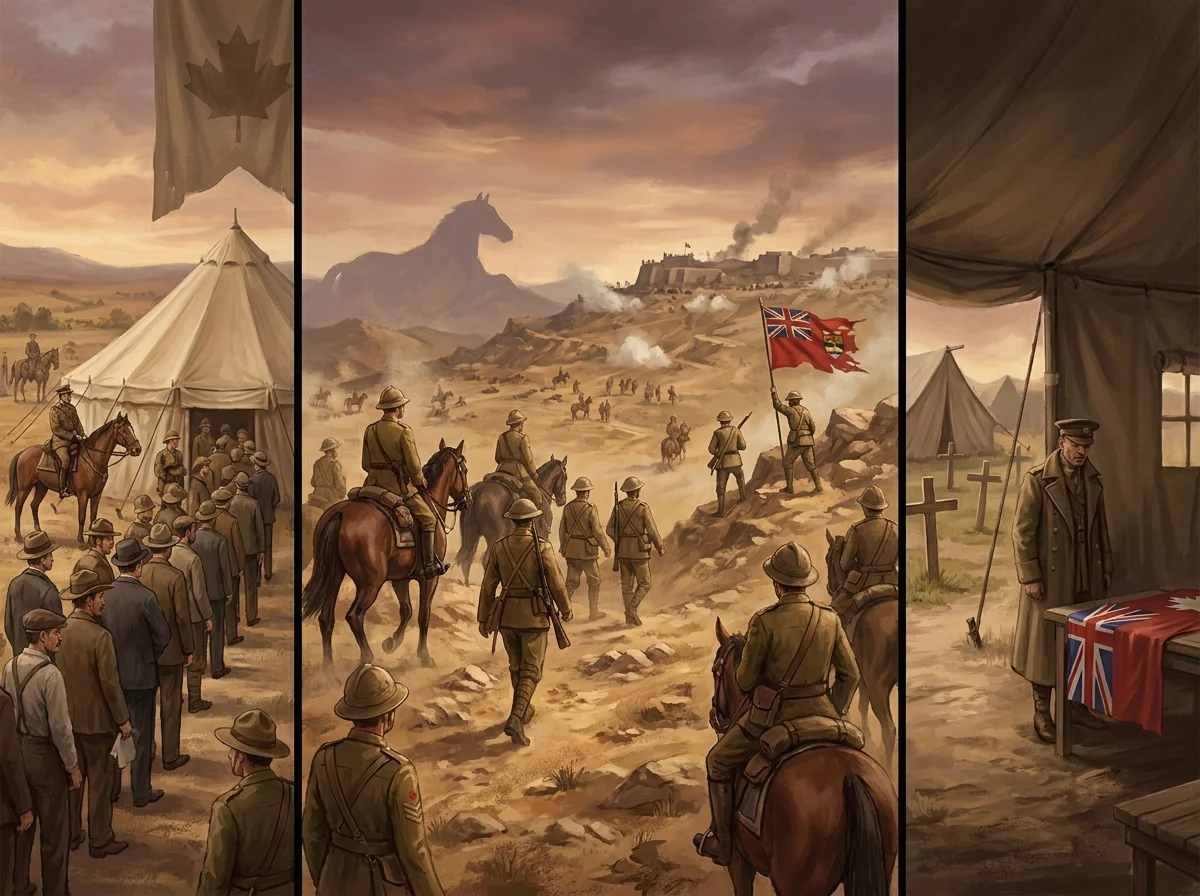
Belgium and France came under German attack in 1914, and Britain then declared war. Ottawa answered by raising the Canadian Expeditionary Force, later known as the Canadian Corps. The country held only eight million people, yet more than 600,000 Canadians served, most of them as volunteers. The Royal Canadian Army Medical Corps took in over 3,000 nurses, nicknamed the "Bluebirds," and 2,500 of these women went overseas. In battle, Canadian soldiers showed themselves tough and inventive.
Key Facts
- 1914: a German attack on Belgium and France brings Britain into war
- Ottawa raised the Canadian Expeditionary Force, renamed the Canadian Corps
- Over 600,000 Canadians served, from a population of eight million
- 3,000 nurses called "Bluebirds" served; 2,500 went overseas
On the Western Front, Canada knew both tragedy and triumph. Vimy Ridge fell to the Canadian Corps in April 1917. The cost was heavy: 10,000 Canadians killed or wounded. That victory made their reputation for valour secure, and they earned the nickname "shock troops of the British Empire." A Canadian officer described the moment. The whole country, from ocean to ocean, was on parade, he said, and in those few minutes he watched a nation being born. Vimy Day falls on April 9.
Key Facts
- The Canadian Corps took Vimy Ridge in April 1917
- 10,000 Canadians were killed or wounded at Vimy
- Their nickname: "shock troops of the British Empire"
- Vimy Day is marked on 9 April
Not everything done at home was honourable. Between 1914 and 1920 Ottawa interned more than 8,000 former subjects of Austria-Hungary as "enemy aliens." Most of them were Ukrainian men. They were held in 24 labour camps spread across Canada. Britain had advised against this policy, but Ottawa went ahead with it anyway. It is remembered today as a regrettable act.
Key Facts
- 1914–1920: over 8,000 former Austro-Hungarian subjects interned
- Most internees were Ukrainian men, labelled "enemy aliens"
- They were held in 24 labour camps across Canada
- Britain had advised against the policy
In 1918 the Canadian Corps fought the war's last hundred days under General Sir Arthur Currie, the man called Canada's greatest soldier. Beside them fought French and British Empire troops. Their victory at Amiens came on August 8, 1918, and the Germans named it "the black day of the German Army." Then came Arras and Canal du Nord, then Cambrai and Mons. Austria and Germany surrendered, and the Armistice came on November 11, 1918. Canadian losses reached 60,000 killed and 170,000 wounded. National and imperial pride grew stronger, above all in English Canada.
Key Facts
- Sir Arthur Currie commanded the Canadian Corps; a reserve officer, he was called Canada's greatest soldier
- Victory at Amiens, 8 August 1918 - Germany's "black day"
- Armistice signed on 11 November 1918
- 60,000 Canadians killed and 170,000 wounded
Test yourself on this topic
7 practice questions from “The First World War”, each with the answer explained.
- How many Canadians volunteered to fight in the South African (Boer) War?
- How many Canadians served in the First World War, and out of what population?
- When did the Canadian Corps capture Vimy Ridge?
- Who commanded the Canadian Corps during the last hundred days of the war?
- Who did Ottawa intern as "enemy aliens" between 1914 and 1920?
- What did the Germans call the Battle of Amiens of August 8, 1918?
- What were Canada's losses in the First World War?
Advertisement