⚖️ Chapter 5: How Canadians Govern Themselves
5.5.2 Provincial and Territorial Governments
2 paragraphs · 6 questions
Every province and territory has an elected legislature of its own, and that is where its own laws are passed. What an elected member is called depends on where you are. Four titles are in use: member of the Legislative Assembly (MLA), member of the National Assembly (MNA), member of the Provincial Parliament (MPP) and member of the House of Assembly (MHA). The titles differ, but the job is the same: an elected lawmaker at provincial or territorial level.
Key Facts
- Each province and territory has an elected legislature
- Members may be MLAs, MNAs, MPPs or MHAs
- The title used depends on the province or territory
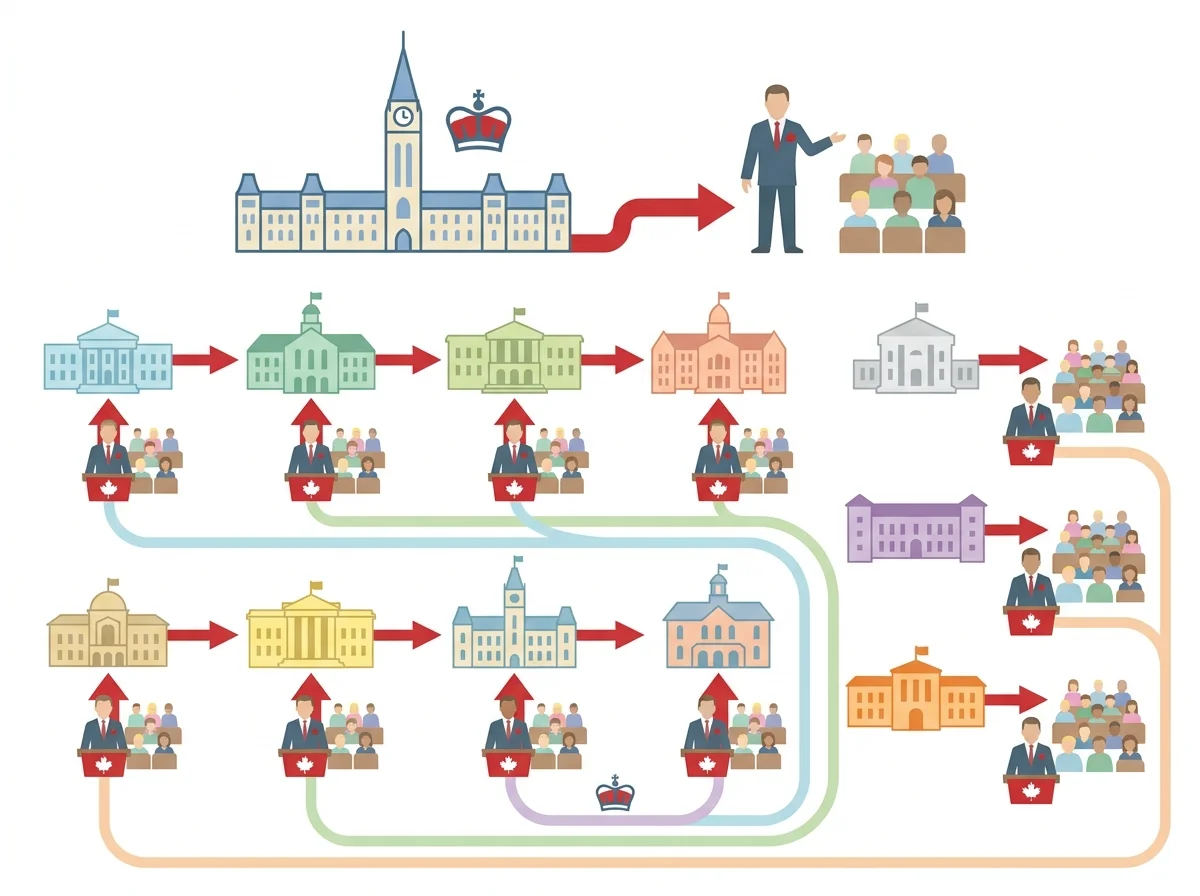
The roles in a province mirror the ones in Ottawa. A province is led by a Premier, whose job resembles the Prime Minister's at the federal level. The Lieutenant Governor plays a part much like the Governor General's. The three territories work a little differently. Each has a Commissioner, who stands for the federal government there. The Commissioner's role is a ceremonial one, so it is not the same as heading the territorial government.
Key Facts
- A Premier leads a province, as the Prime Minister leads federally
- A Lieutenant Governor's role mirrors the Governor General's
- Each of the three territories has a Commissioner
- The Commissioner represents the federal government in a ceremonial role
Test yourself on this topic
6 practice questions from “Provincial and Territorial Governments”, each with the answer explained.
- Where are provincial and territorial laws passed?
- Which title is used for members of some provincial legislatures?
- A provincial Premier's role is similar to whose role in Ottawa?
- A Lieutenant Governor's role in a province is similar to whose federal role?
- Who represents the federal government in each of the three territories?
- What kind of role does a territorial Commissioner play?
Advertisement