
🗳️ Chapter 6: Federal Elections
6.1.1 Federal Elections
4 paragraphs · 10 questions
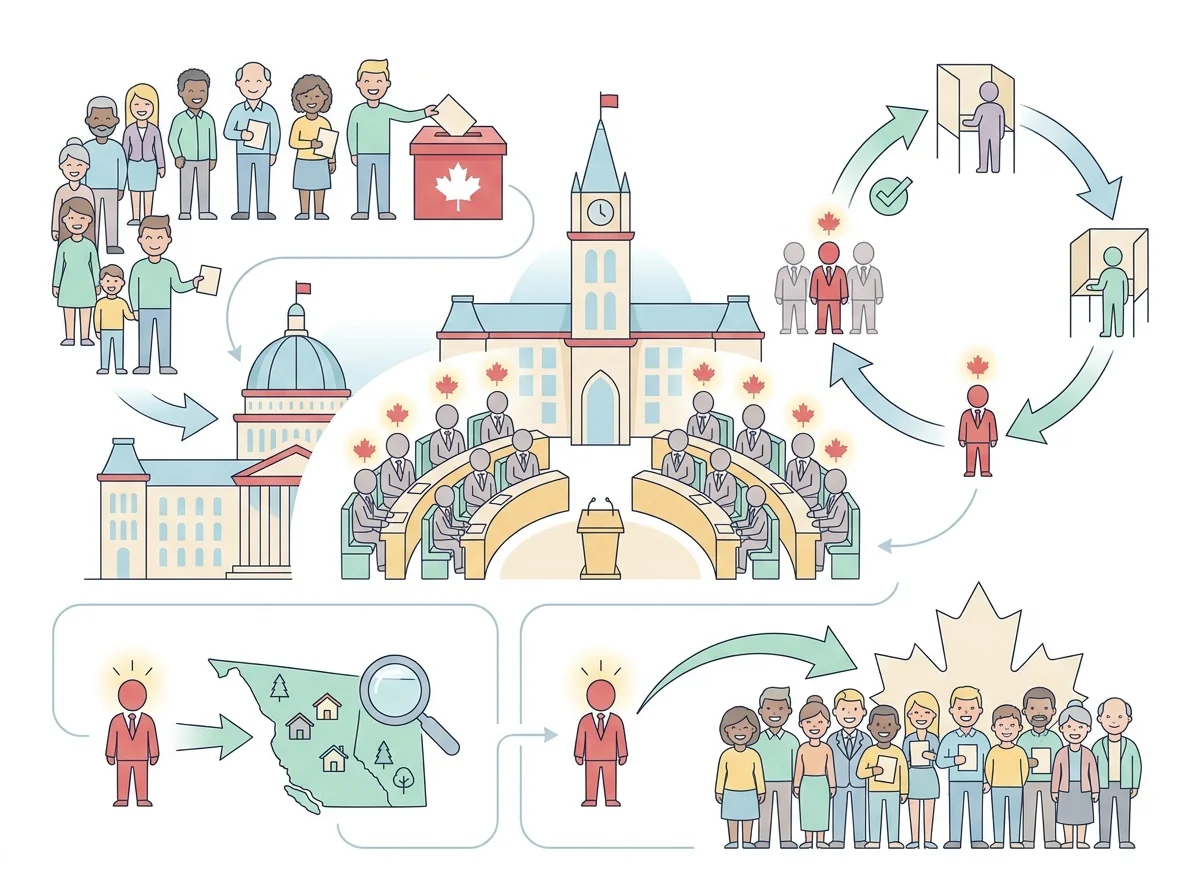
Voters choose the people who will speak for them in the House of Commons. Those elected people are called members of Parliament, or MPs for short. At every election you may keep the same MPs or pick different ones. It is your decision each time. Once elected, an MP takes a seat in the House of Commons. That MP speaks for the people who live in their own area, and also for Canadians everywhere.
Key Facts
- Canadians vote for representatives in the House of Commons
- Members of the House of Commons are called MPs
- Voters can re-elect the same MPs or choose new ones
- An MP represents their own area and all Canadians
A law passed by Parliament fixes the date of federal elections. The date falls on the third Monday in October, four years after the last general election. That fixed date is not always the one used, however. The Prime Minister may go to the Governor General and ask for an election earlier than planned. So voters can be called to the polls before the four years have run out.
Key Facts
- Fixed election day: the third Monday in October
- Elections come four years after the last general election
- The Prime Minister may ask the Governor General for an earlier election
The country is divided into electoral districts. Two other names for the same thing are ridings and constituencies. A district is simply an area of land with borders drawn on a map. In 2012 there were 308 of them. Voters in each district elect one MP, and only one. That MP then sits in the House of Commons. There the MP speaks for the local people and for the whole country.
Key Facts
- Electoral districts are also called ridings or constituencies
- A district is a geographic area on the map
- In 2012 there were 308 electoral districts
- Each district elects exactly one MP
People who want a seat put their names forward. They are known as candidates. To run in a federal election you must hold Canadian citizenship and be 18 years old or older. One district can have several candidates on the ballot paper. Voters look at both the person standing and the political party behind that person. Counting is simple: whoever collects the highest number of votes in that district wins and becomes its MP.
Key Facts
- People who run for office are called candidates
- Candidates must be Canadian citizens aged 18 or older
- There can be many candidates in one district
- The candidate with the most votes becomes the MP
Test yourself on this topic
10 practice questions from “Federal Elections”, each with the answer explained.
- Canadians vote in federal elections to fill seats in which body?
- Members of the House of Commons are also known by what name?
- Under the law passed by Parliament, when is a federal general election normally held?
- Who may ask the Governor General to call an election before the fixed date?
- Which two words are also used to mean an electoral district?
- What is an electoral district?
- An MP represents the voters of their own district and who else?
- What is the minimum age for a Canadian citizen to run in a federal election?
- What do we call the people who run for office in an election?
- In an electoral district, which candidate becomes the MP?
Advertisement