👨⚖️ Chapter 7: The Justice System
7.3.1 Courts
3 paragraphs · 7 questions
Canada has several levels of court. At the very top sits the Supreme Court of Canada, the highest court in the country. No court ranks above it. Standing apart from that is the Federal Court of Canada. It handles matters that concern the federal government. Knowing these two names is important, and so is knowing the difference: one is the highest court of all, the other deals with federal government business. Below them come the courts run by the provinces, and those are the courts that handle most of the cases ordinary people are involved in.
Key Facts
- The Supreme Court of Canada is the country's highest court
- The Federal Court of Canada deals with federal government matters
- Provincial courts handle most everyday cases
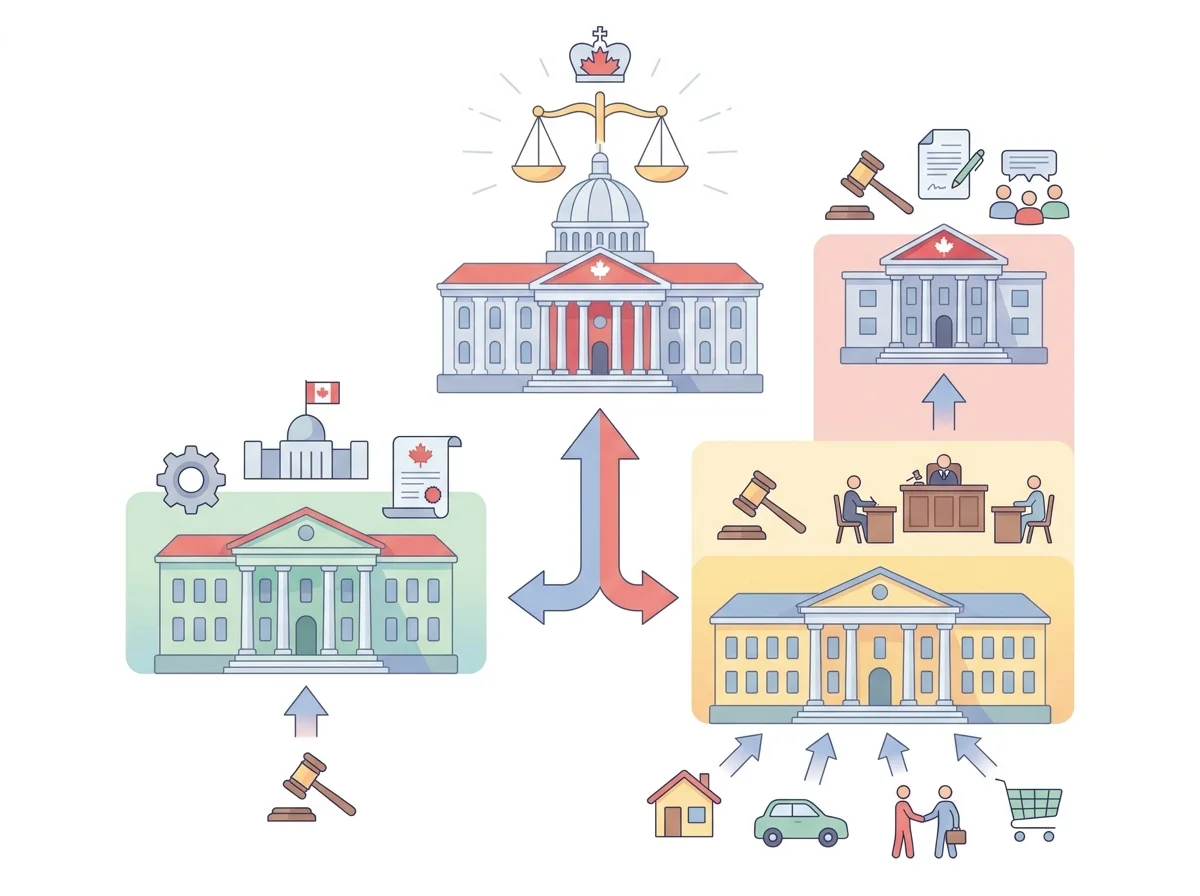
Most provinces run two main courts of their own: an appeal court and a trial court. The trial court does not carry the same name everywhere. In some provinces it is known as the Court of Queen's Bench. In others it is called the Supreme Court. That second name can confuse newcomers, because a provincial Supreme Court is not the Supreme Court of Canada, which is the highest court in the land. Courtrooms at this level may contain jury benches — the seats where a jury sits. When you learn the structure, keep the provincial names and the national one apart.
Key Facts
- Most provinces have an appeal court and a trial court
- The trial court may be called the Court of Queen's Bench or the Supreme Court
- A provincial Supreme Court is not the Supreme Court of Canada
- Jury benches are the seats where a jury sits in a courtroom
Provinces also run more specialized courts for everyday matters. Provincial courts deal with lesser offences. There are family courts and traffic courts as well. Small claims courts hear civil cases where only small amounts of money are at stake, so people can settle modest disputes without a long and costly trial. Between them, these courts deal with a very large share of the legal problems that people meet in ordinary life. If you ever need to go to court yourself, it will most likely be one of these, not the Supreme Court of Canada.
Key Facts
- Provincial courts deal with lesser offences
- There are also family courts and traffic courts
- Small claims courts handle civil cases over small amounts of money
Test yourself on this topic
7 practice questions from “Courts”, each with the answer explained.
- Which is the highest court in Canada?
- Which court handles matters that concern the federal government?
- In most provinces, which two kinds of court exist?
- In some provinces, what other name is used for the trial court?
- Which court hears civil cases involving small amounts of money?
- Where are lesser offences dealt with?
- Which of these is a specialized court in Canada?
Advertisement