🏛️ Chapter 3: Canada's History
3.3.4 Responsible Government
2 paragraphs · 4 questions
Upper and Lower Canada were joined into one colony in 1840, the Province of Canada. Robert Baldwin and Sir Louis-Hippolyte La Fontaine were reformers who pressed British governors for responsible government, and Joseph Howe pushed the same cause in Nova Scotia. Several reformers of that period went on to be named Fathers of Confederation, among them Sir George-Étienne Cartier and Sir Étienne-Paschal Taché. Sir John A. Macdonald was one of them too; earlier he had served in Upper Canada's voluntary government militia.
Key Facts
- 1840: the Province of Canada formed from Upper and Lower Canada
- La Fontaine and Baldwin pushed for responsible government
- Joseph Howe did the same work in Nova Scotia
- Taché, Cartier and Macdonald all became Fathers of Confederation
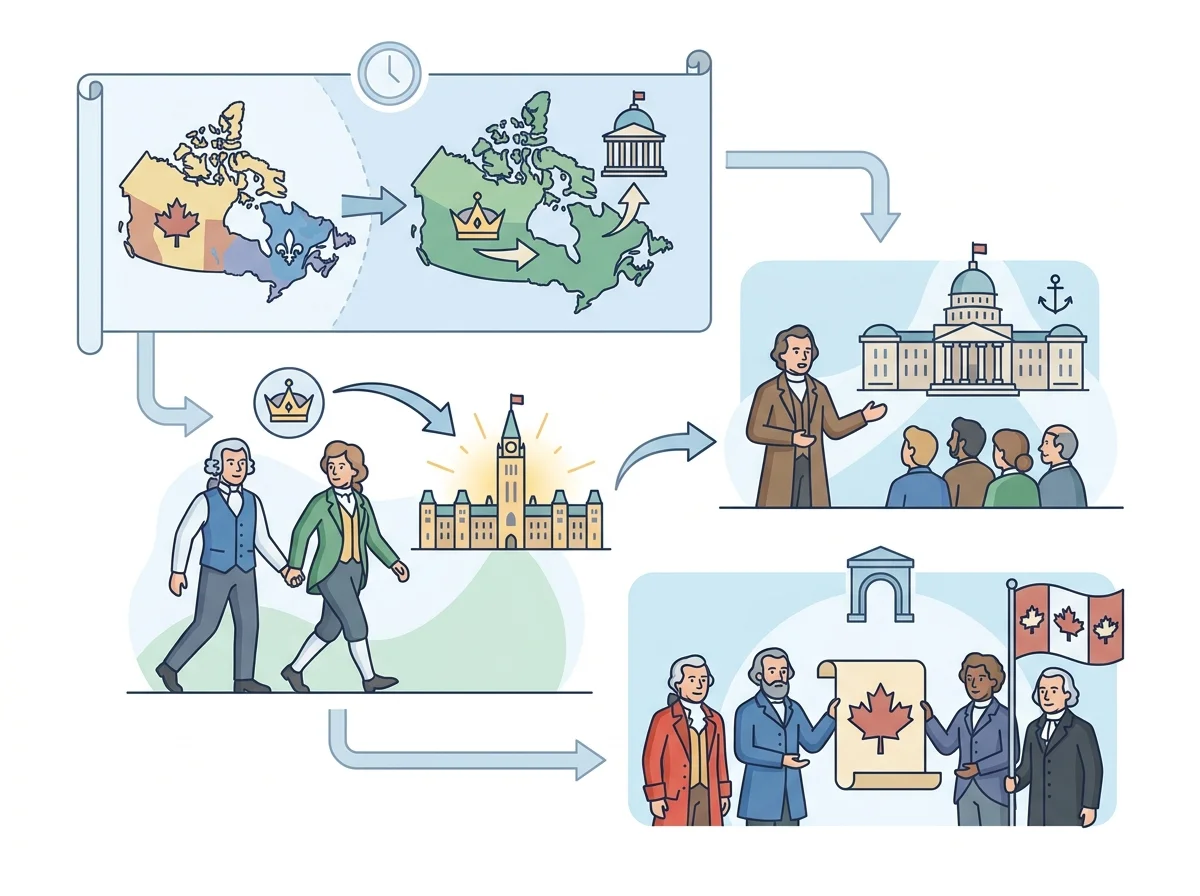
Nova Scotia got there first. In 1847-48 it became the earliest colony in British North America with full responsible government. Lord Elgin, who governed United Canada, brought the same system in during 1848-49, with London urging him on. Canada still works this way. When a government loses a vote of confidence in the assembly, it has to resign. La Fontaine, a defender of democracy and of French language rights, then led the first responsible government formed in the Canadas.
Key Facts
- Nova Scotia reached full responsible government first, in 1847-48
- Lord Elgin brought it to United Canada in 1848-49
- A government that loses a vote of confidence has to resign
- La Fontaine led the first responsible government formed in the Canadas
Test yourself on this topic
4 practice questions from “Responsible Government”, each with the answer explained.
- What happened to Upper and Lower Canada in 1840?
- Which colony was first in British North America to win full responsible government?
- Under responsible government, what must a government do if it loses a confidence vote?
- Who led the first responsible government in the Canadas?
Advertisement